
Joy Brown: Clay and Wood Firing - A Way of Life
The Log Book, Issue 57, February 2014
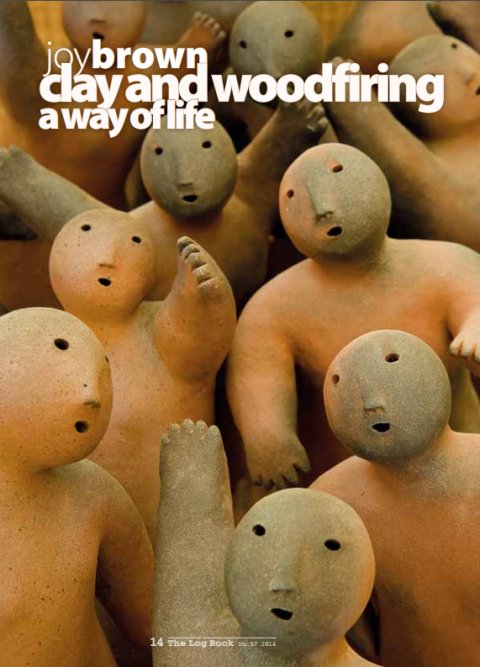
Group of Figures from 108 Dancing Ladies by Joy Brown, each approx. 31 cm in height, 2009, Photograph: Richard Wanderman
We don't always know what pulls us to do what we do ...
As far back as I can remember, I've played with clay and fire. When we were little, my brother and I would pull the red wagon up the road from our house, to the hill near by where they were doing excavation and dig up the exposed clay. We would haul it home to make things and dry them in the sun. We had a place in our back yard, behind the fence which separated us from the well groomed garden of my parents, where we would dig tunnels and light fires, burning everything we could find. I benefited from being the last of four kids in our family, growing up in an environment of benevolent neglect where I was free to do what I wanted to do, to go where my dreams led me. Like many of you, I have been drawn to clay and fire all my life.
I grew up in Japan as my father founded a hospital in Osaka, in the early 1950s. After majoring in art at Eckerd College, Florida, USA, I returned to Japan and worked as an apprentice with Toshio Ichino, a 13th generation potter in Tamba. In this traditional apprenticeship, after working all day for the family studio, I would do my own practice at night. I was to throw sake cups, only sake cups, thousands of them, all year long, never firing one. Though it was an extremely difficult year I learned not only the techniques of working with clay, but also developed an intuitive connection to the clay and the capacity to be present in the process. This experience has had a profound impact on my work that continues even now. It is the process that is most important, the quality of attention that we bring to it. The pieces that result will reflect the spirit and skill with which they are made.
Then I was fortunate to study for several years with Shigeyoshi Morioka in the mountains of Wakayama Prefecture. He is a free spirit in clay, a prolific and talented potter making yakishime, unglazed woodfired work. Having been influenced by Koyama Fujio's Tanegashima pottery, Morioka uses a local high-iron roof tile clay, firing to a relatively low temperature (about 1200°C) in his anagama. In sharing his work, life, aesthetic and passion for clay, I learned a way of life. Clay and woodfire became a centering force in my life. Morioka is still a good friend, like a brother, and still an inspiration.
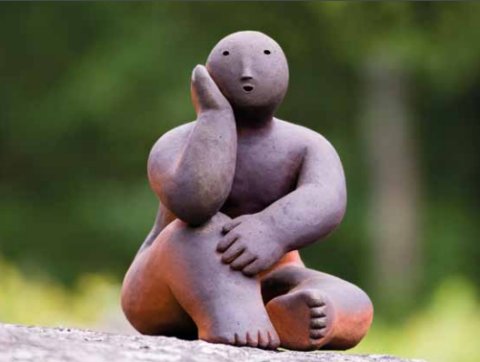
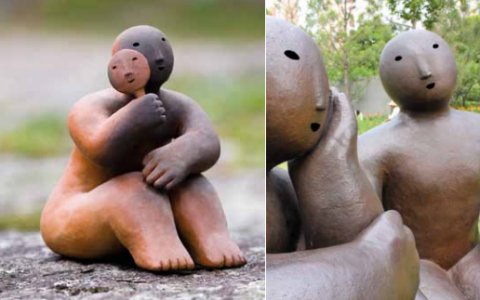
Sitter with Head in Hand by Joy Brown, 46 cm in height, 2010, Photograph by Richard Wanderman
I remember the first time I saw one of Morioka's unglazed wood-fired sake bottles. It looked rough, strange and unfinished. I wasn't sure that I liked it but I was drawn to it, there was something compelling about it, something mysterious. I thought there must be a lot here that I don't know. Little did I know then that I would be pulled there all my life. When I came to the States after my apprenticeship I thought of myself as a potter. I was trained as a potter, making unglazed woodfired vessel forms, and that's how I intended to make my living. In my play, however, puppet heads and animal forms began to emerge. Over the past thirty years these forms have evolved organically into the figures I make today. These figures remind me of that peaceful place in myself -- calm, open, aware.
After researching clays from all over, I resonated with a red brick clay in Georgia that fires beautifully to about 1200°C in the long slow firing of the anagama. The owners of the mine send me the tailings -- the rough and varied particles, that are screened out at the mine and I mix them back in to make my hearty clay. I've been working with this clay ever since.
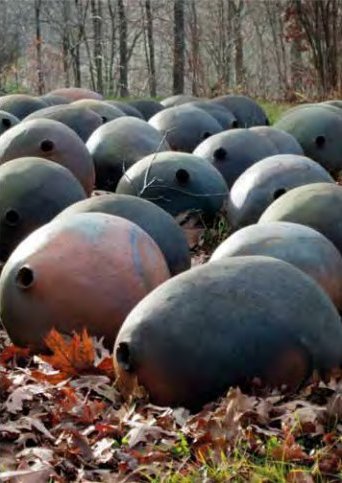
Part of a series of 108
pods by Joy Brown,
each approximately
33 cm in height, 2013.
Photograph: Joy Brown.
About thirty years ago I
built my studio and kiln here in
Connecticut (USA), on land that
came to me fortuitously from a
childhood friend in Japan. The
anagama (10m long, 1.3m wide,
1m high) is made with twenty-eight
tons of high temperature brick,
salvaged from an abandoned
industrial site (bricks that I
collected, brick by brick, truck load
by truck load over the previous five
years!). The kiln is covered with an
outer layer of insulation brick and
adobe. It has a large opening to fit
big pieces, and a gentle slope to
create a slow draught during firing,
to achieve the soft effects that are
an integral part of my work. The
kiln is larger than I can fill on my
own in order to include work by
other ceramic artists. We fire once a year, the firing
process taking about a month,
to load, fire, cool, and clean the
pieces. The kiln holds about a
year's worth of my work plus the work of other ceramic artists that come
to fire. The firing is about eight days, four days of warm up, and four
days raising temperature to approximately 1300°C in front. The last day
we stoke the side holes to raise the temperature in the back to about
1170°C, then build coals throughout the kiln to fire the temperature down
slowly. We carefully select the team to fire day and night, first 6 hours
shifts, then 12 hour shifts for the last several days. It is a symbiotic relationship regarding the kiln as most potters are
drawn to the hotter temperature and heavier, more dramatic ash effects
in the front. The best place for my work is in the back two thirds, where
the long woodfiring at the relatively low stoneware temperature brings out the soft clay colours, layered with a dusting of ash that compliments
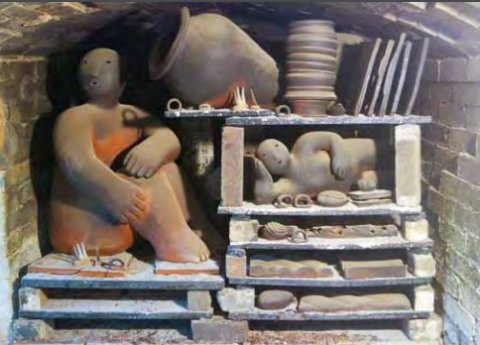
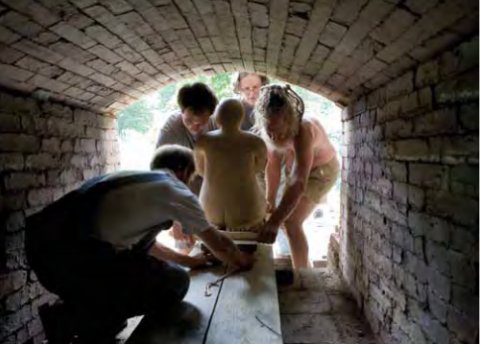
my forms Unpacking the
anagama at Joy
Browns studio.
Photograph: Joy Brown
This firing has become a crossroads for some of the most amazing
people involved in the arts and ceramics over the 28 years we've been
firing, professional ceramic artists as well as neighbours and friends.
There is a hard core group of us too, who have been firing together for
decades. Many of us work alone in clay and the coming together for
this annual firing is a real celebration and ritual. Mutual appreciation and
commitment to the firing and the beautiful results in our work brings us
here. We grow up, turn from 34 years old to 62 (!), have babies, (and they
grow up ... and help fire!), marry, divorce, get sick, heal ... sharing in it
all. We meet each other and ourselves on a deep level in the joys and
difficulties of this process.
Loading a figure in
the anagama, from
left, Jimmy Griffin, Ryo
Brown-McClain, Joy
Brown and Bill Fischer.
Photograph: Richard Wanderman
Woodfiring is still a thrill after these 40 years! Still a compelling
challenge to explore the relationship between the clay I have chosen, the
kiln and firing, my developing shapes, and my own evolving intentions.
Us woodfirers ... we never get tired of looking into the kiln, wood
burning, pots glowing red. We are humans around the fire, at the hearth,
sometimes together, sometimes alone. When I was an apprentice, firing
Morioka's anagama, I would be the night shift. I loved that shift best,
especially in the early days of the firing. No distraction... quiet... just me
and the fire, watching the flames moving through the kiln, the dark red pots turning to orange,
the mysterious carbon webs, tracking the tip of the flame, the sound and smell of wood burning,
heating up that piece of lasagne on the top of the kiln, drawing, writing... the stillness pulling me
to that quiet place in myself. A refuge. Now I don't take the night shift because of responsibilities
in the daytime, but I get great joy when I see someone savouring it as much as I did! (and I get
good sleep!)
I have been blessed with some wonderful teachers: my parents, Shigeyoshi Morioka, Denny
Cooper, my mentor for 25 years. Inspired by this work with clay, woodfiring, and community,
Denny and I founded a non-profit organization in the arts, Still Mountain Center. Its purpose is to
support and celebrate artistic exchange by providing opportunities for cross-cultural appreciation,
collaboration and innovation in the arts. For me, it is a way to share my work, what I learned in living
and working in Japan, the techniques, aesthetics and attitude of life with clay and the values of a
dual cultural experience. The woodfiring is a microcosm of what Still Mountain Center represents.
In working together in this creative process we learn about ourselves and can support each other
in doing what we love.
For twenty years I had been working in bronze, making small pieces at a local foundry, until
several years ago when I had an incredible opportunity to work in China, making large-scale
bronzes. I go to Shanghai several times a year to build the original forms in plaster and do the
finishing work on the bronzes.
I have always wanted to go to China. My grandparents met there in the early 1900s and lived
there for forty years, and my father was born and raised there. In my childhood I heard many stories
about China and Chinese people whom he
loved. I now work closely with a small team
there and have gotten to know them, fondly,
in these past three years. Working with
the woodfire kiln has trained me to be able
to guide, teach and learn from them as we
make my work together. I believe the pieces,
whether ceramic or bronze, reflect the spirit in
which they are made.
Left: Sitter with Mask by Joy Brown, 48 cm in
height, 2011,
Photograph: Richard Wanderman.
The aesthetic of my woodfiring has influenced
these big bronze ladies. The patina
that looks best in bronze looks a lot like the
effects from my anagama. The guys at the
foundry kid me about making ceramic figures
that look like bronze, and bronze pieces that
look like ceramic.
I am grateful for having been able to make
my living from my work in clay all these years,
selling what I love to make. The first 20 years
of my pottery life were focused on developing
a relationship with the clay and kiln, with great
respect and attention. I have come to realize
in the past 20 years that the relationships with
people who respond to my work take the
same kind of care and connection. Sharing
one's work with others is one of the most
rewarding aspects of being an artist. When
someone sees, understands, and appreciates
what I make, a conversation begins. I learn
and grow from the collaboration. The circle is
complete.
Right: Close-up of bronze figures by Joy Brown,
each 190 cm in height, 2012.
Photograph: Joy Brown.