
Joy Brown
by Tracey O'Shaughnessy
Portfolio, Passport, Litchfield County Times
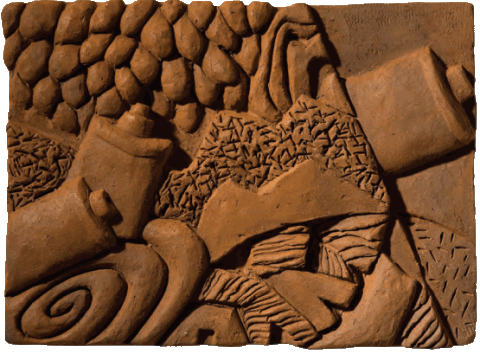
Joy Brown's work, all wood-fired stoneware, includes the wall relief "Untitled."
Somewhere, in Joy Brown's snugly organic house high on a ridge in Kent, there is a cup. It is a small, earthenware object, no more than two inches high and not more than that in diameter, whose form, heft, discolorations and proportions lodge in the lush membrane between memory and sensation so integral to Brown's art.
The cup is one of thousands that Brown made as an apprentice in a primitive village in Tamba, Japan, in 1974. The cups were never fired. They were never used. But Brown, the daughter of American missionaries, threw cup after cup every evening under the direction of her mentor, Toshio Ichino, in a village that had created pottery for 13 generations. At the end of the evening, the cups were thrown into the same muck of clay from which they had come, and Brown did not consider the act wasteful, but enlightening. It wasn't just an exhausting tutorial on the transcience of life and effort. For Brown, it worked to dissolve the boundary between the cerebral and the sensual, between thought and creation.
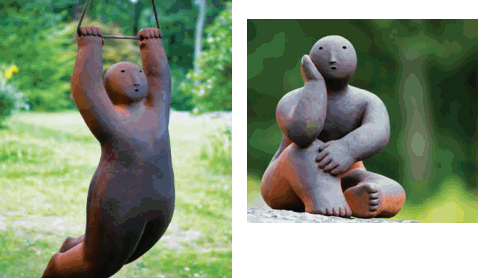
Left: Swinging; Right: Sitter with Head in Hand
"We threw those cups thousands and thousands of times," says Brown, 58. "You're throwing it and trimming it and understanding the thickness of the clay, how the lip turns, the balance of the cup. And in the process your own thinking is dropping back and your're being with the clay. It's developing your intuitive connection to the clay. It's not coming from a thinking place. It's sheer process." Brown, a tall, hale-looking woman with handsome features and soft gray eyes, breathes deeply. "It makes you more whole in a way."
Joy Brown is no longer throwing pots into the abyss, but the equilibrium she developed from years of discipline in Japan reveals iself in the serene, self-composed sculptures that have earned her praise over the last 22 years. She is among the state's premier ceramic artists and the firing of her meticulously assembled wood-fired kiln has become something of a regional celebration, like the bonfire of some Yankee shaman.
Perhaps it is her talismanic figures, which bound and vault, soar and skip, consider and console. These wood-ash ceramic sculptures are ageless, sexless, neutral naifs, open-mouthed and wide-eyed, neither Caucasian or Asian, young nor old. The guileless, earth-toned beings--squat, thick figures, all bald, with ample limbs and flat, squarish feet, regard the viewer with a mixture of wisdom and wonder. Their wide-eyed gazes manage to be both artless and incriminating. These are figures of disarming candor that insinuate themselves into the viewer's consciousness, like children looking for the truth.
"They're kind of how I'd like to be: relaxed, alert, inquisitive," says Brown.
All of that seems to aptly describe the artist, who grew up in Japan and then bounced back and forth across the Pacific as a 20-something, trying to find her footing. Ultimately, she landed in Pine Plains, N.Y., where she studied with Paul Chaleff, and then in Wingdale, N.Y., a craft village where she thought she'd satisfy the market's urge for shimmering trinkets by making shiny, glazed pots.
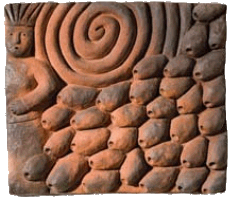
Left: Spiral and Pods
But none of it really seemed to gel until she moved to Kent in 1984, building her house, and then her studio and kiln, on this rustic knoll, where her enigmatic sculptures now greet visitors with an inquisitive conviviality. The sculptures are hand-built from Georgia clay of a moist, ochre color, which Brown coils and then presses into forms, striking them with a light paddle, a little bigger than a ruler, to give them shape. Often, the creatures have their knees pulled up or together in a kind of good-natured alertness. These are figures in the act of listening, a bit like the young apprentice Joy Brown, learning that discipline was the first step to creative awareness as she made sake cups from which no one would ever drink.
"You're pulling on your physical, your emotional, your mental capacities and talents to make these things," she says. "You're not controlling the clay, you're collaborating with it. It's a relaxed awareness and you flow with the material."